Global Lab Advantage.
Accredited facility.
Standards compliance.
Experienced analysts.
Fast, reliable reporting.
Field + Lab capability.
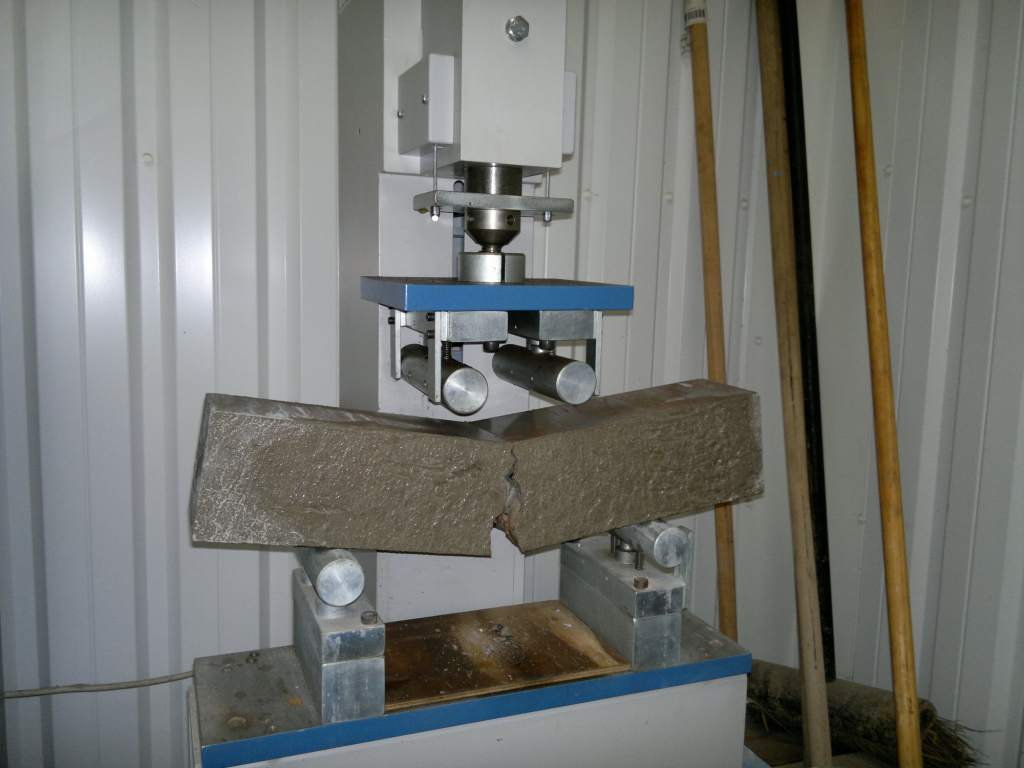
Flexural strength represents concrete’s ability to resist tensile stresses generated by bending. This makes it a key parameter for understanding cracking behavior in slabs, pavements, and structural elements where bending governs performance rather than pure compression.
For rigid pavements, floors, and runways, design is primarily based on flexural strength rather than compressive strength. The test ensures that concrete can withstand repeated wheel loads and bending stresses without premature cracking or failure.
Flexural strength is closely linked to deflection control and crack width development. Reliable test results help engineers ensure that concrete elements remain serviceable, minimizing visible cracking, surface distress, and long-term deterioration.
The flexural strength test is an effective tool for comparing concrete mixes, aggregates, admixtures, and curing methods. It helps verify consistency in production and confirms that the concrete mix performs as intended under realistic loading conditions.
NDT TESTING
Accredited Facility: NABL-accredited laboratory with traceable calibration and stringent Quality System procedures.
Compliance with Standards: Tests conducted in accordance with relevant IS/ASTM/RILEM/EN standards.
Experienced Personnel: Technologists and experts who interpret results and recommend mitigation strategies.
Rapid and Reliable Reporting: Valid reports that comply with relevant standards.
Testing Capabilities: Lab and on-site testing, along with post-test consulting services.
Accredited facility.
Standards compliance.
Experienced analysts.
Fast, reliable reporting.
Field + Lab capability.
Applications
Design and quality control of rigid pavements, highways, and airport runways.
Performance evaluation of industrial floors and concrete slabs.
Assessment of precast concrete beams and panels.
Comparative studies of concrete mixes, fibers, and admixtures.
Verification of concrete performance for infrastructure and transportation projects.
NABL Accredited
Advanced Lab & Field Testing
Fast Turnaround Reports
Digital Data & Traceability
On-Site Testing Across India
Global Lab provides comprehensive testing for construction and engineering materials, including concrete, cement, steel, aggregates, bitumen, soil, tiles, paver blocks, and other civil and infrastructure materials. We also handle customized tests as per client or project specifications.
Material testing ensures that every component used in a structure meets the required strength, durability, and safety standards. It helps prevent structural failures, ensures long-term performance, and guarantees compliance with national and international standards.
Yes. Global Lab is an NABL-accredited and ISO-certified facility. All our tests are carried out in accordance with the latest IS, ASTM, BS, and EN standards to maintain accuracy, reliability, and traceability of results.
Yes. Our team is equipped with mobile testing facilities and field instruments for on-site sampling, inspection, and testing — ensuring quick and reliable results without disrupting your project timelines.
We follow a wide range of standards including IS (Bureau of Indian Standards), ASTM (American Society for Testing and Materials), BS (British Standards), and EN (European Norms) — depending on project or client requirements.
Yes. We provide digital test reports with QR-code verification, ensuring easy access, authenticity, and transparency for clients, consultants, and contractors.
With years of experience, NABL accreditation, and thousands of successful test reports delivered, Global Lab has built a reputation for accuracy, transparency, and technical integrity. Our results are accepted by top builders, government bodies, and consultants across India.
Global Lab serves a broad range of industries — including construction, infrastructure, real estate, government projects, precast manufacturers, RMC plants, and consultants — offering reliable testing, calibration, inspection, and proficiency services.
Adding {{itemName}} to cart
Added {{itemName}} to cart