
Tensile Stress Under Restrained Shrinkage
(Ring Test — ASTM C1581)
Assessment of concrete cracking tendency under restrained shrinkage using the standard ring test — predicting age at first crack and cracking risk for high-performance and low shrinkage concrete.
What is the Tensile Stress Under Restrained Shrinkage?
The Restrained Shrinkage Ring Test casts a concrete annulus around a steel ring. As the concrete shrinks, the steel ring restrains it, inducing tensile stress. The test measures the age of first crack and strain development rate in the steel ring — providing the shrinkage cracking tendency under restrained conditions.
This test is critical for evaluating concrete mixes for bridge decks, parking structures and industrial floors where restrained shrinkage cracking is a durability concern. At Global Lab, ring tests are conducted alongside free shrinkage and autogenous shrinkage for a complete cracking risk profile.
Tensile Stress Under Restrained Shrinkage — Site Images
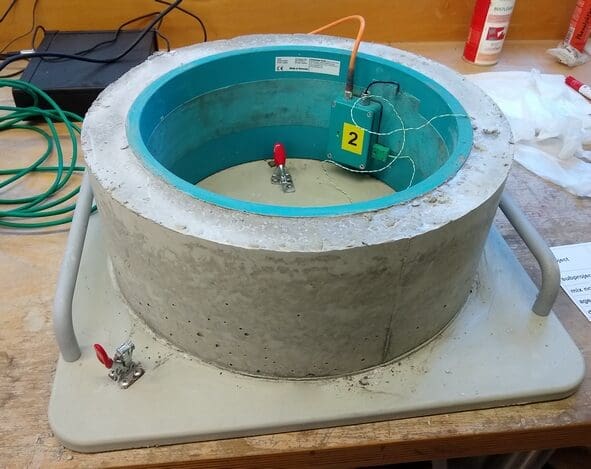
How the Tensile Stress Under Restrained Shrinkage is Conducted
-
1Ring Formwork SetupSteel ring (inner radius 152mm) instrumented with strain gauges. Outer formwork placed.
-
2Concrete CastingConcrete cast in annulus around steel ring. Surface sealed with aluminium tape.
-
3Controlled EnvironmentRing specimens stored at 23°C, 50% RH per ASTM C1581.
-
4Strain MonitoringSteel ring strain monitored continuously. Sudden drop indicates crack formation.
-
5Analysis & ClassificationAge of cracking and strain rate recorded. ASTM C1581 Table 1 classification applied. NABL report within 28 days.
Applicable Test Standards
| Standard | Title | Scope | Type |
|---|---|---|---|
| ASTM C1581 | Standard Test Method for Determining Age at Cracking and Induced Tensile Stress Characteristics of Mortar and Concrete under Restrained Shrinkage | Ring Test | ASTM |
| AASHTO T334 | Estimating the Cracking Tendency of Concrete | Cracking Tendency | AASHTO |
| ACI 231R | Report on Early-Age Cracking: Causes, Measurement, and Mitigation | Early Cracking | ACI |
| IS 516 | Methods of Tests for Strength of Concrete | Concrete Testing | Indian Standard |