
Concrete USPV Test
(Ultrasonic Pulse Velocity)
Assessment of concrete quality, homogeneity and estimated strength by measuring the travel time of ultrasonic pulses through concrete — detecting internal cracks, voids and variations in concrete quality.
What is the Concrete USPV Test?
The Concrete Ultrasonic Pulse Velocity (USPV) Test measures the time taken for an ultrasonic pulse to travel through a known length of concrete. The pulse velocity is correlated to concrete quality, compressive strength and homogeneity. Lower velocities indicate voids, cracks or poor consolidation; higher velocities indicate denser, better quality concrete.
Conducted as per IS 13311 Part 1 and ASTM C597, the USPV test is widely used for both quality control on new construction and condition assessment of existing structures. Global Lab uses calibrated digital USPV instruments with transducers optimised for both direct and indirect transmission modes.
Concrete USPV Test — Site Images
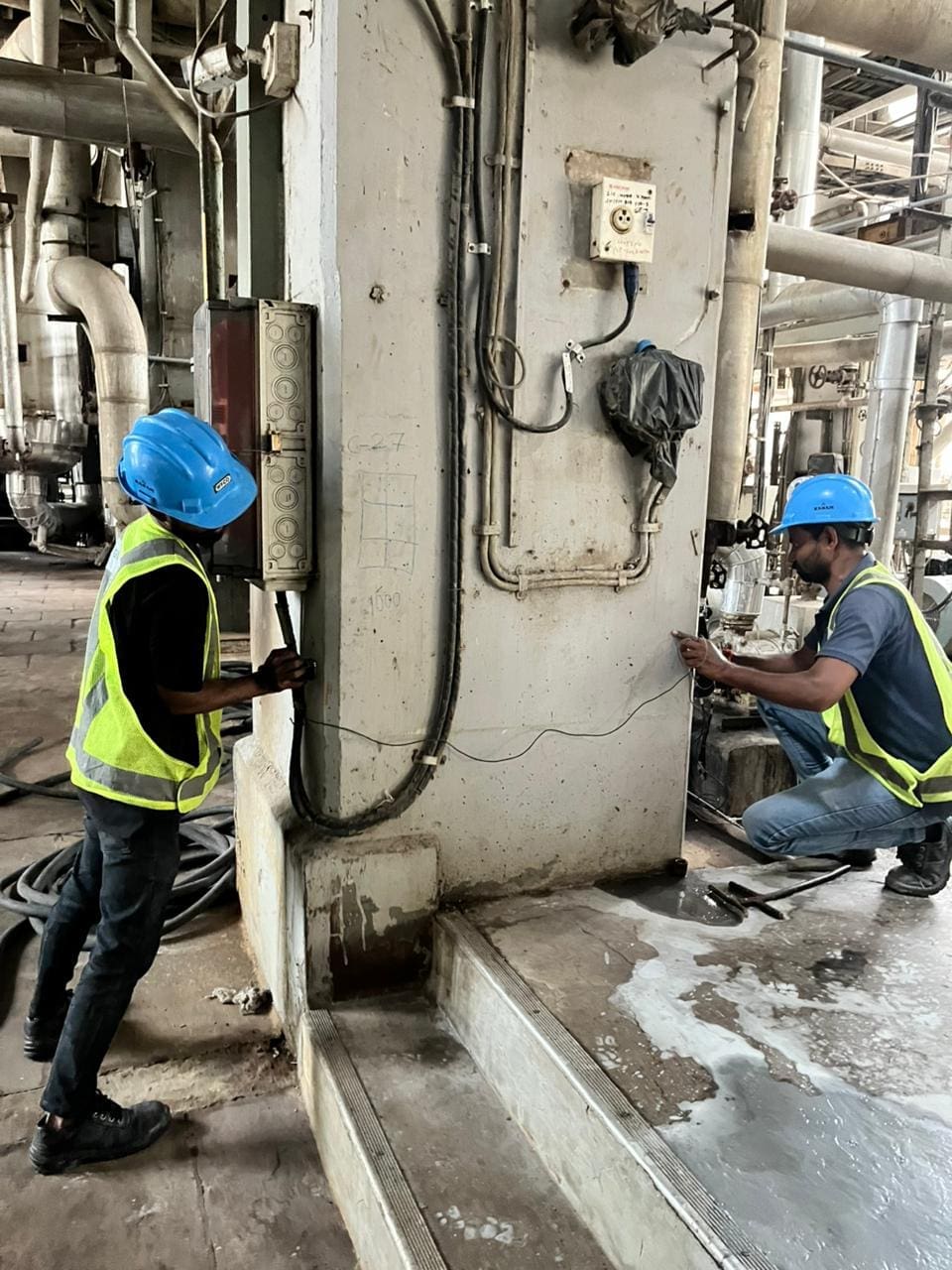

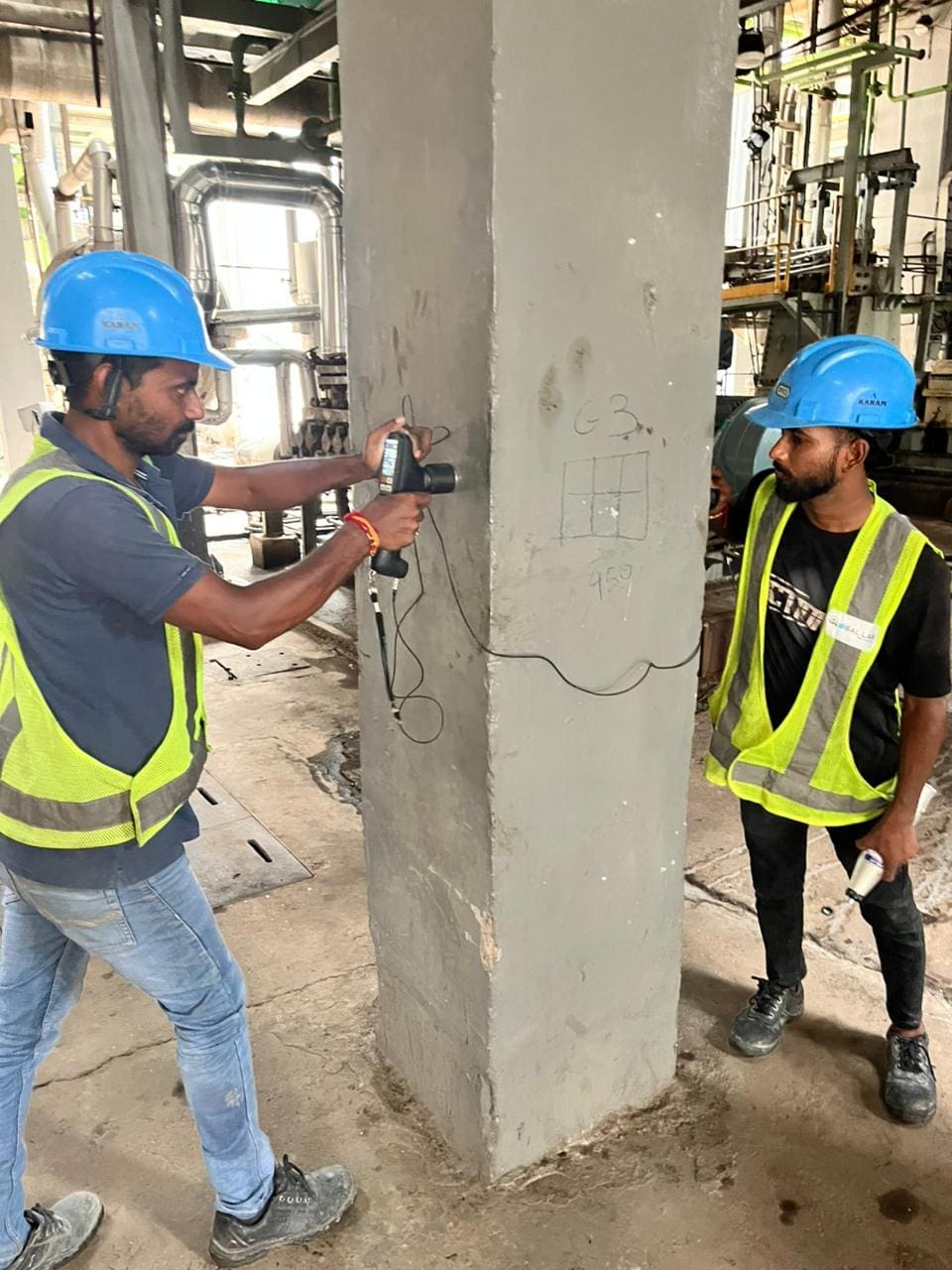
How the Concrete USPV Test is Conducted
-
1Surface PreparationSurfaces are cleaned and coupling gel is applied at transducer contact points to ensure good acoustic coupling.
-
2Transducer PlacementTransmitter and receiver transducers are placed on opposite faces (direct), adjacent faces (semi-direct) or same face (indirect) depending on accessibility.
-
3Pulse TransmissionAn electronic pulse generator produces a high-voltage pulse through the transmitter transducer, launching an ultrasonic wave into the concrete.
-
4Travel Time MeasurementThe receiver transducer detects the pulse and the transit time (in microseconds) is measured and displayed digitally.
-
5Velocity Calculation & ReportingPulse velocity = Path Length ÷ Transit Time. Velocity is classified per IS 13311 Table 1. NABL report with velocity contour map issued within 24 hours.
Applicable Test Standards
| Standard | Title | Scope | Type |
|---|---|---|---|
| IS 13311 Part 1 | Methods of Non-Destructive Testing of Concrete — Ultrasonic Pulse Velocity | USPV Test | Indian Standard |
| ASTM C597 | Standard Test Method for Pulse Velocity Through Concrete | Pulse Velocity | ASTM |
| BS EN 12504-4 | Testing Concrete — Determination of Ultrasonic Pulse Velocity | NDT | British Standard |
| EN 13791 | Assessment of In-situ Compressive Strength in Structures | Strength Assessment | European Standard |