
Concrete Crushing Strain in Compression
(Ultimate Compressive Strain — IS 456)
Measurement of ultimate compressive strain of concrete at crushing — providing the strain capacity parameter for IS 456 and ACI 318 ductility-based structural design of columns and beams.
What is the Concrete Crushing Strain in Compression?
The Concrete Crushing Strain Test measures the compressive strain in concrete at the point of crushing failure. IS 456 assumes a limiting compressive strain of 0.0035 for design, but actual values depend on concrete grade, aggregate type, confinement and loading rate — critical data for HPC ductility assessment.
Conducted per IS 516 and ASTM C469 using electrical strain gauges and servo-controlled loading, the complete stress-strain curve with ultimate strain is essential for non-linear structural analysis of HPC columns, seismic design and performance-based design.
Concrete Crushing Strain in Compression — Site Images
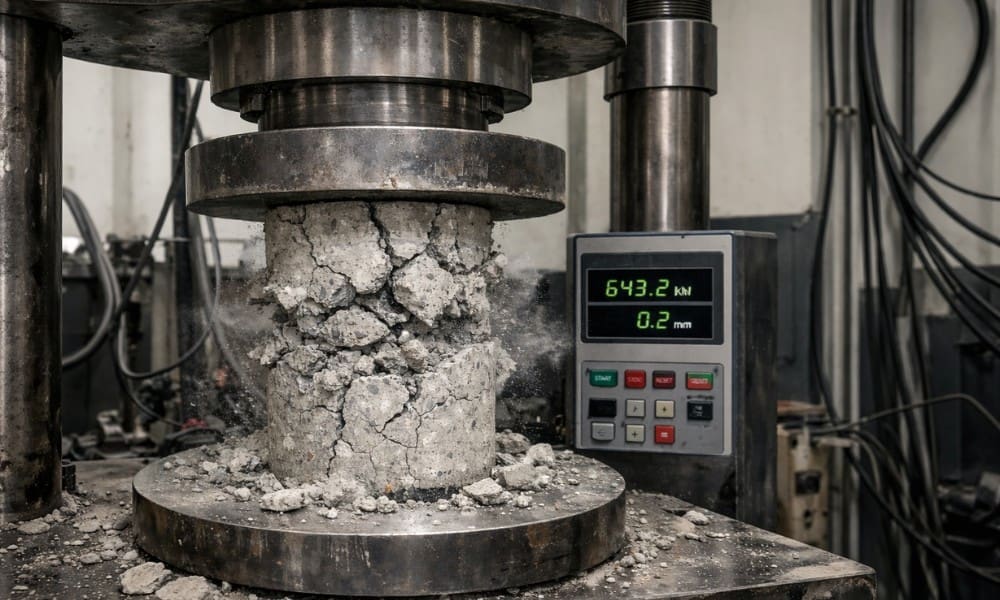
How the Concrete Crushing Strain in Compression is Conducted
-
1Specimen Preparation150×300mm cylinders prepared. Ends ground flat. Strain gauges bonded at mid-height.
-
2Servo CTM SetupClosed-loop servo CTM set up with stroke control for stable post-peak testing.
-
3Strain Gauge & CompressometerElectrical strain gauges and compressometer calibrated and attached.
-
4Monotonic Compression to FailureStrain-controlled loading applied until crushing. Load, stress and strain recorded continuously.
-
5Ultimate Strain & Modelεcu at crushing identified. Mander or Popovics stress-strain model fitted. NABL report within 35 days.
Applicable Test Standards
| Standard | Title | Scope | Type |
|---|---|---|---|
| IS 516 | Methods of Tests for Strength of Concrete | Concrete Testing | Indian Standard |
| ASTM C469 | Standard Test Method for Static Modulus of Elasticity and Poisson's Ratio | Modulus & Strain | ASTM |
| IS 456:2000 | Plain and Reinforced Concrete — Code of Practice | Design Reference | Indian Standard |
| ACI 318 | Building Code Requirements for Structural Concrete | Design Code | ACI |