
Split Tensile Strength Test of Concrete
(Brazilian Test — IS 5816)
Indirect measurement of the tensile strength of concrete by applying diametrical compression to a cylindrical specimen — providing tensile strength data for structural design and mix design validation.
What is the Split Tensile Strength Test of Concrete?
The Split Tensile Strength Test (Brazilian Test) determines the tensile strength of concrete indirectly by loading a 150mm diameter × 300mm cylinder in diametrical compression along a narrow strip. This induces a uniform tensile stress along the vertical diametrical plane, causing splitting failure. Concrete tensile strength is approximately 8–12% of compressive strength.
Conducted as per IS 5816 and ASTM C496, split tensile strength is used in structural design for flexural member cracking prediction, in pavement design (tensile fatigue), and as a quality indicator for concrete mixes incorporating fibres, SCMs or special admixtures. Global Lab tests split tensile strength at 7 and 28 days in our NABL-calibrated CTM.
Split Tensile Strength Test of Concrete — Site Images
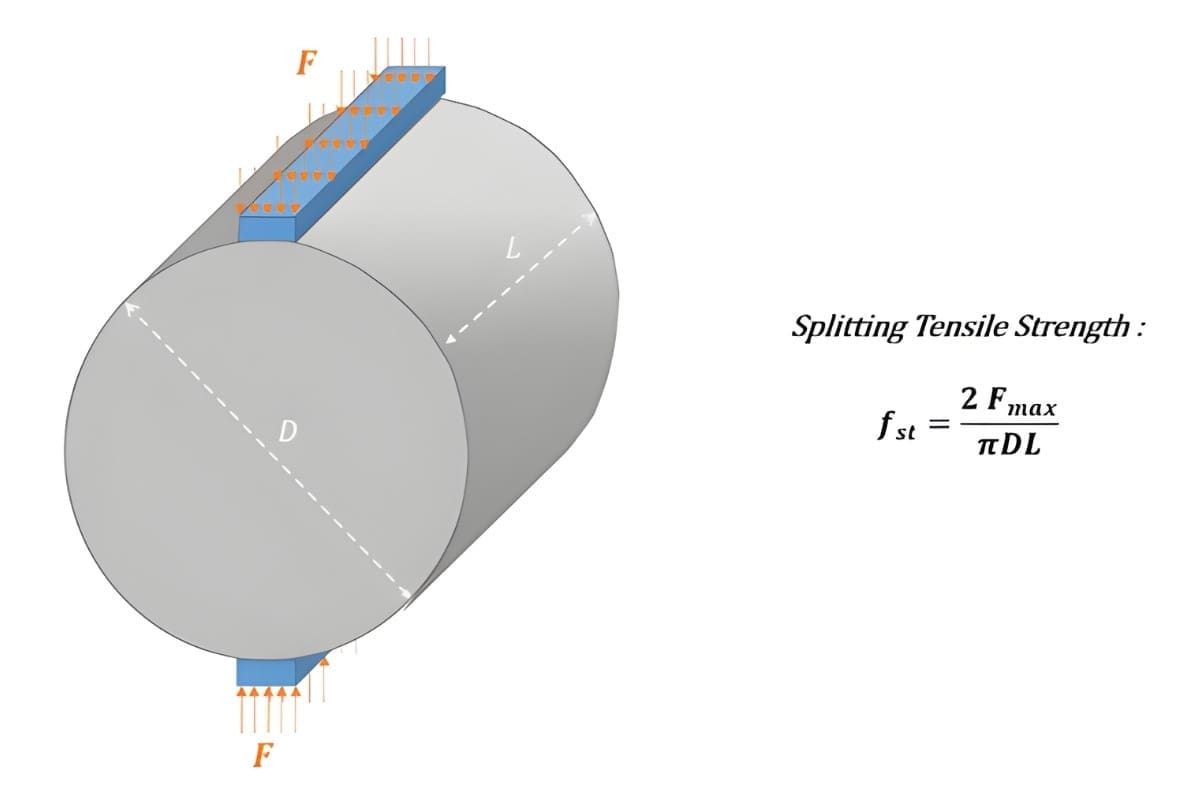

How the Split Tensile Strength Test of Concrete is Conducted
-
1Specimen Preparation150×300mm cylinders cast per IS 516 and cured at 27±2°C for test age.
-
2Bearing Strip PlacementTwo thin plywood bearing strips (3mm thick × 25mm wide) placed along top and bottom of cylinder.
-
3CTM SetupCylinder positioned with bearing strips along a diametrical plane in NABL-calibrated CTM.
-
4Load ApplicationCompressive load applied at 1.2–2.4 kN/s per IS 5816 until splitting failure along diametrical plane.
-
5Tensile Strength Calculationfct = 2P / (πLD). Results at 7 and 28 days reported. NABL report issued.
Applicable Test Standards
| Standard | Title | Scope | Type |
|---|---|---|---|
| IS 5816 | Method of Test for Splitting Tensile Strength of Concrete | Split Tensile | Indian Standard |
| ASTM C496 | Standard Test Method for Splitting Tensile Strength of Cylindrical Concrete Specimens | Split Tensile | ASTM |
| IS 456:2000 | Plain and Reinforced Concrete — Code of Practice | Structural Concrete | Indian Standard |
| IRC 58 | Guidelines for the Design of Plain Jointed Rigid Pavements | Pavement Design | IRC |