
Track Ballast Testing
(Railway Ballast — IRS GE/1)
Complete mechanical and physical testing of railway track ballast as per IRS GE/1 — covering aggregate impact value, abrasion, crushing value, particle size distribution, flakiness and elongation for track acceptance.
What is the Track Ballast Testing?
Track Ballast is the crushed stone aggregate placed on railway track beds to distribute load from sleepers to subgrade, provide drainage, resist lateral and longitudinal movement of track, and absorb vibration. Ballast quality is governed by strict physical and mechanical requirements per IRS GE/1 (Indian Railways Standard).
At Global Lab, track ballast testing covers the complete IRS GE/1 test suite including Aggregate Impact Value (AIV ≤20%), Los Angeles Abrasion Value (LAA ≤30%), Aggregate Crushing Value (ACV ≤25%), particle size distribution (40–65mm grading), flakiness index (≤25%), elongation index (≤25%), water absorption and specific gravity — mandatory tests for all railway ballast procurement in India.
Track Ballast Testing — Site Images
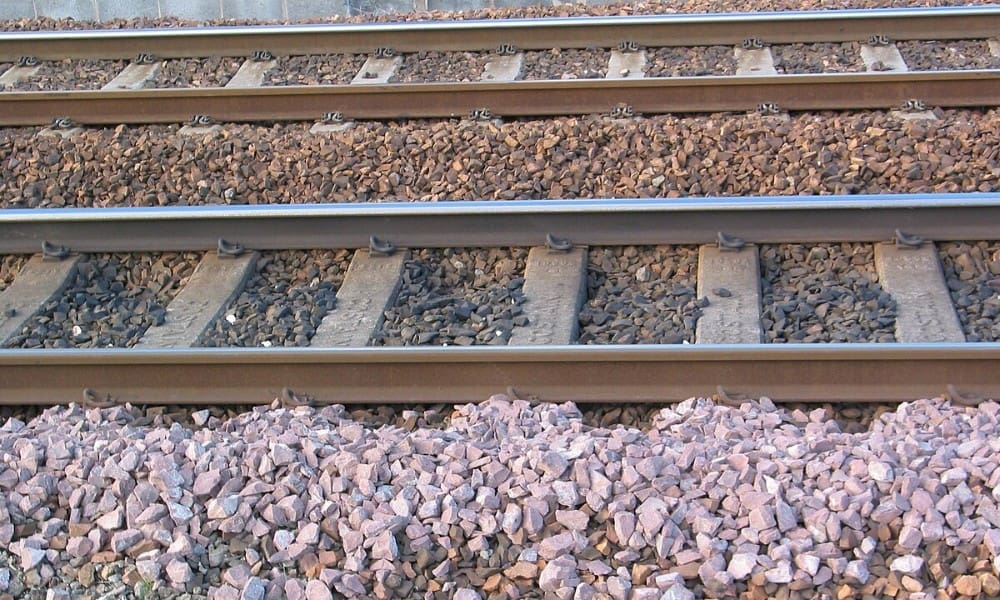
How the Track Ballast Testing is Conducted
-
1Sample CollectionBallast sample collected per IRS GE/1 sampling procedure — minimum 500kg field sample reduced to test portions.
-
2Particle Size DistributionSieve analysis using 65, 50, 40, 25, 20mm sieves. Grading plotted against IRS GE/1 envelope.
-
3Shape TestsFlakiness index (IS 2386 Part 1) and elongation index tested on 40–65mm fraction.
-
4Mechanical TestsAIV (IS 2386 Part 4), ACV (IS 2386 Part 4), LA Abrasion (IS 2386 Part 4) conducted.
-
5Physical Tests & ReportSpecific gravity and water absorption per IS 2386 Part 3. All results vs IRS GE/1 limits. NABL report within 7 days.
Applicable Test Standards
| Standard | Title | Scope | Type |
|---|---|---|---|
| IRS GE/1 | Indian Railways Standard Specification for Track Ballast | Railway Ballast | Indian Railways |
| IS 2386 | Methods of Test for Aggregates for Concrete (Parts 1–8) | Aggregate Testing | Indian Standard |
| IS 383:2016 | Coarse and Fine Aggregate for Concrete — Specification | Aggregate Reference | Indian Standard |
| RDSO Guidelines | Research Design and Standards Organisation — Track Ballast | RDSO | Indian Railways |