
Galva Pulse Test
(Linear Polarization Resistance)
In-situ electrochemical measurement of the corrosion rate of reinforcing steel in concrete — providing real-time data on steel passivity and active corrosion activity without any damage to the structure.
What is the Galva Pulse Test?
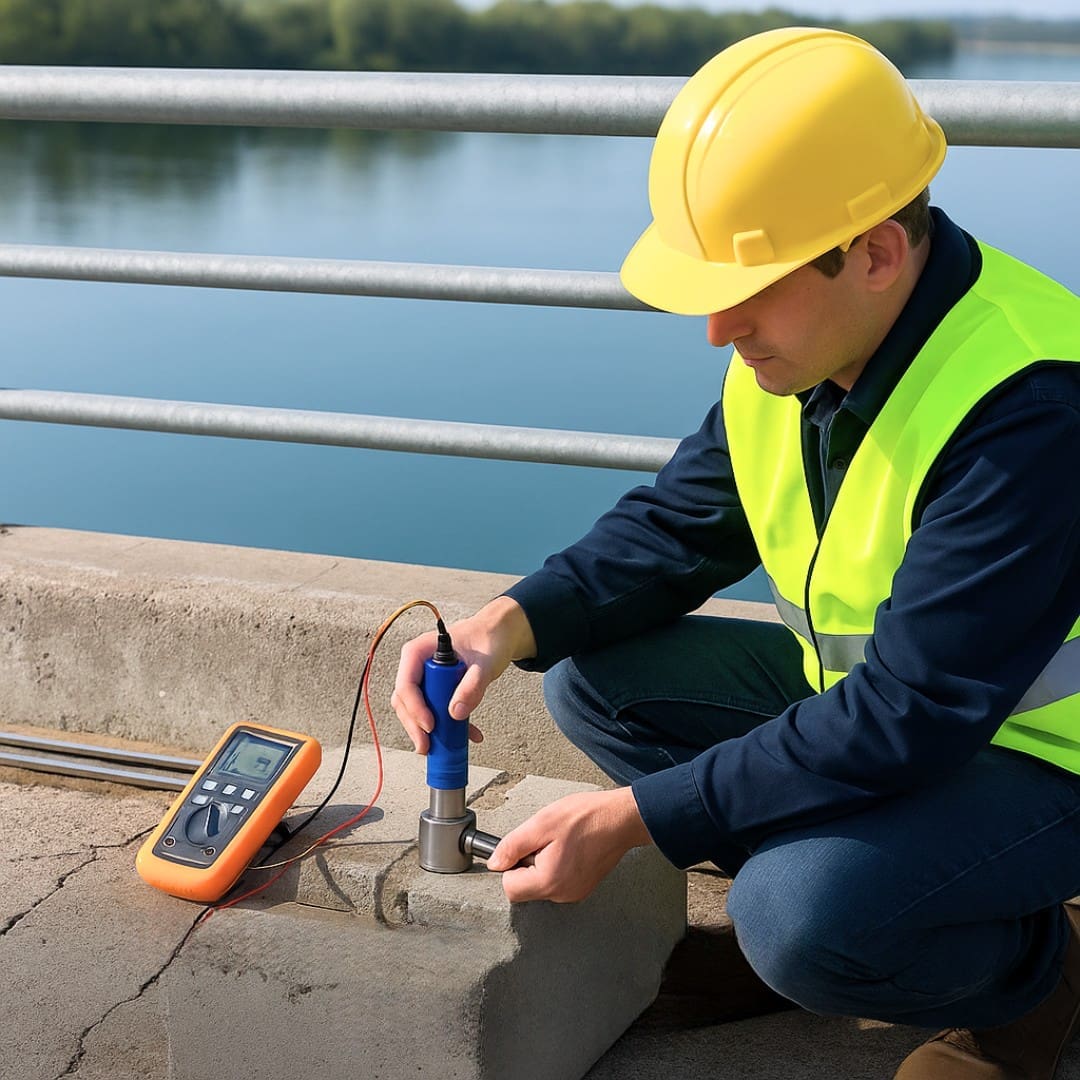
The Galva Pulse Test (Linear Polarization Resistance — LPR) is an advanced non-destructive electrochemical method used to quantitatively measure the corrosion rate of reinforcing steel embedded in concrete. A small galvanic pulse is applied to the rebar surface and the resulting polarization resistance is measured to calculate the instantaneous corrosion rate.
This test is conducted as per ASTM C876 and provides both qualitative (half-cell) and quantitative (corrosion rate) data. At Global Lab, our site engineers use calibrated Galvapulse instruments across pan-India projects for structural assessment, rehabilitation planning and condition monitoring.
Galva Pulse Test — Site Images

How the Galva Pulse Test is Conducted
-
1Surface PreparationConcrete surface is lightly ground or wetted to ensure good electrical contact. Rebar connection point is identified and cleaned.
-
2Sensor PlacementThe Galvapulse sensor guard ring is placed on the concrete surface directly over the reinforcement bar.
-
3Galvanic Pulse ApplicationA small galvanic pulse current is applied to the rebar through the sensor. The counter electrode is placed in the guard ring.
-
4Polarization Resistance MeasurementThe instrument measures the shift in potential during the applied pulse — calculating polarization resistance (Rp).
-
5Corrosion Rate Calculation & ReportingCorrosion current density (Icorr) is calculated from Rp using Stern-Geary constant. NABL report issued with corrosion risk classification.
Applicable Test Standards
| Standard | Title | Scope | Type |
|---|---|---|---|
| ASTM C876 | Standard Test Method for Corrosion Potentials of Uncoated Reinforcing Steel in Concrete | Corrosion Potential | ASTM |
| RILEM TC 154-EMC | Recommendations for the Measurement of Corrosion Rates | Corrosion Rate | RILEM |
| BS 1881-Part 201 | Testing Concrete — Guide to Use of Non-Destructive Methods | General NDT | British Standard |
| EN 12696 | Cathodic Protection of Steel in Concrete — Measurement Methods | Electrochemical Test | European Standard |