
Structural Stress Monitoring
(In-Situ Stress Measurement)
Continuous real-time monitoring of stress levels in structural steel and concrete members — using vibrating wire stress meters and strain gauges to track load distribution and detect stress anomalies.
What is the Structural Stress Monitoring?
The Structural Stress Monitoring service measures in-situ stress in structural members by installing calibrated vibrating wire stress meters (in steel) or embedded strain gauges (in concrete) at critical locations. Stress levels are continuously logged and transmitted to a cloud dashboard — providing live structural load data.
Conducted as per ISO 4866 and structural engineering best practices, stress monitoring is essential for bridges under heavy traffic loading, industrial structures supporting dynamic machinery, post-tensioned structures where tendon stress must be verified, and any structure where load redistribution due to settlement or damage is a concern.
Structural Stress Monitoring — Site Images
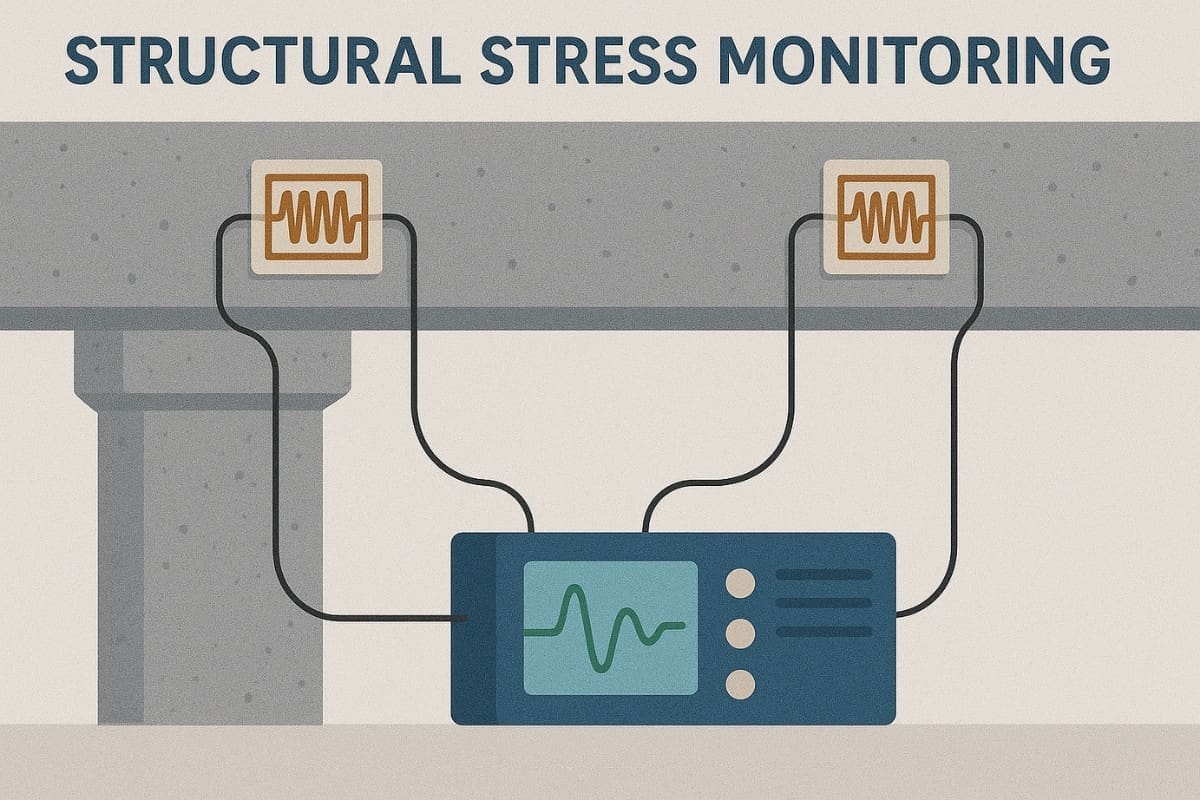
How the Structural Stress Monitoring is Conducted
-
1Critical Location IdentificationStructural analysis identifies high-stress zones — connections, mid-spans, supports.
-
2Sensor InstallationVibrating wire stress meters welded to steel or embedded strain gauges cast into concrete.
-
3Data Logger SetupData logger programmed with sampling rate, channel map and alert thresholds.
-
4Baseline Stress ReadingInitial stress readings taken under known dead load before live load commences.
-
5Continuous Monitoring & ReportLive data streamed to cloud. Monthly interpretation reports issued on NABL letterhead.
Applicable Test Standards
| Standard | Title | Scope | Type |
|---|---|---|---|
| ISO 4866 | Mechanical Vibration and Shock — Vibration of Fixed Structures | Structural Monitoring | ISO |
| IS 1893 | Criteria for Earthquake Resistant Design of Structures | Seismic Monitoring | Indian Standard |
| AASHTO | Guidelines for Instrumentation and Structural Monitoring of Bridges | Bridge SHM | AASHTO |
| IRC 6 | Standard Specifications for Road Bridges — Loads and Stresses | Bridge Loading | IRC |