
Rapid Chloride Migration Test
(RCMT — NT Build 492)
Determination of the chloride migration coefficient of concrete under non-steady state conditions — providing a more fundamental durability parameter than RCPT for service life modelling and design.
What is the Rapid Chloride Migration Test?
The Rapid Chloride Migration Test (RCMT) measures the non-steady state chloride migration coefficient (Dnssm) by applying 30V DC across a concrete disc for 24 hours, then splitting the specimen and measuring the chloride penetration depth using silver nitrate indicator. Dnssm is a fundamental material property used in service life prediction models.
Conducted as per NT Build 492, RCMT provides a true diffusion coefficient in m²/s — far more meaningful for service life design than the empirical Coulomb charge of RCPT. It is specified for marine concrete, bridge deck design and durability-based design per fib Model Code and DuraCrete. Global Lab conducts RCMT alongside RCPT for comprehensive chloride resistance characterisation.
Rapid Chloride Migration Test — Site Images
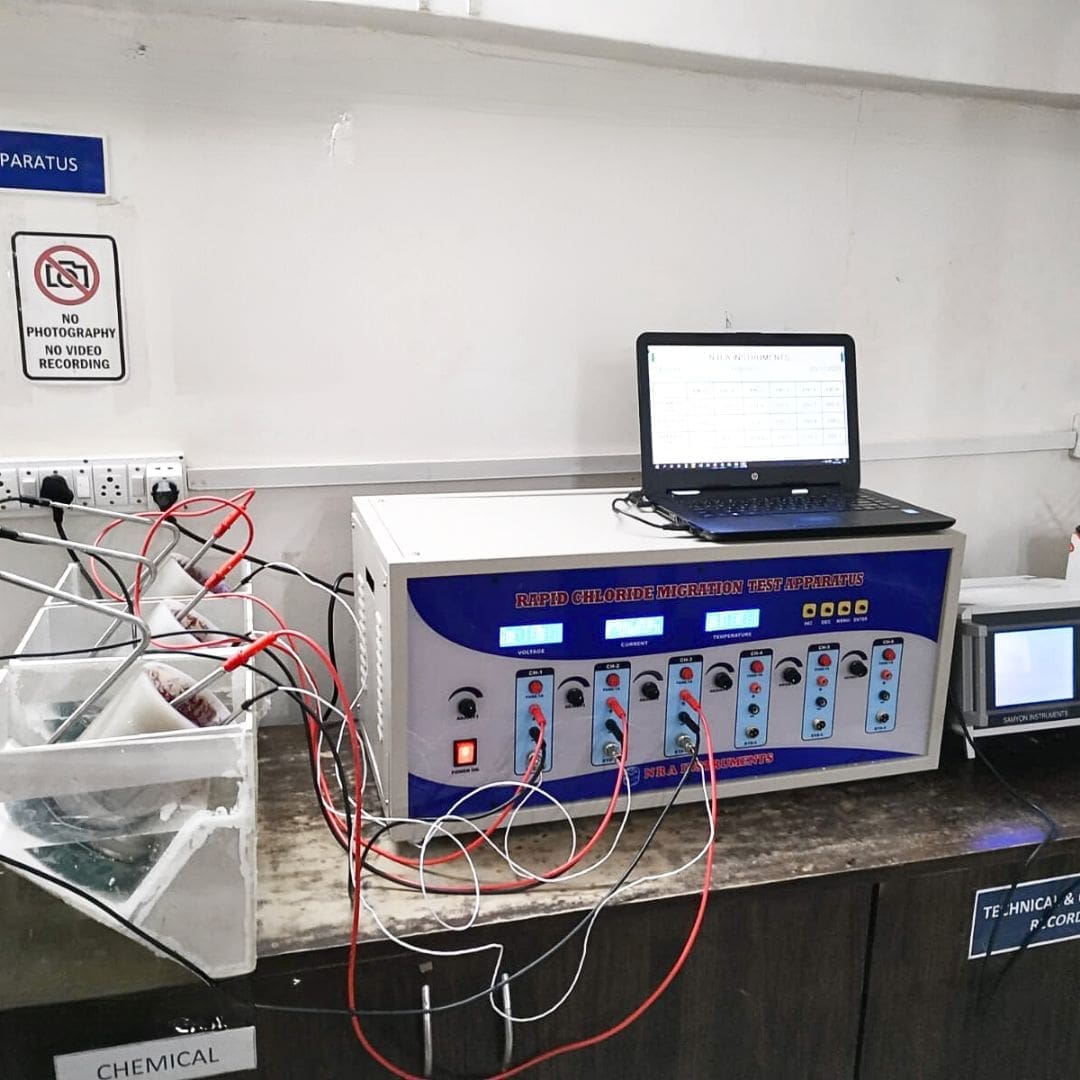
How the Rapid Chloride Migration Test is Conducted
-
1Specimen Preparation50mm thick disc cut from 100mm dia core or cylinder. Vacuum saturated with Ca(OH)₂ solution per NT Build 492.
-
2Cell AssemblySpecimen mounted between catholyte (10% NaCl) and anolyte (0.3N NaOH) chambers.
-
3Voltage & Duration30V DC applied. Initial current measured to determine test duration (6–96 hours).
-
4Chloride Penetration DepthAfter test, specimen split. AgNO₃ solution sprayed on split face. Colorimetric depth measured at 7 points.
-
5Dnssm Calculation & ReportMigration coefficient Dnssm = (0.0239(273+T)L) / (U-2)t × [xd - 0.0238√((273+T)Lxd/(U-2))]. NABL report within 48 hours.
Applicable Test Standards
| Standard | Title | Scope | Type |
|---|---|---|---|
| NT Build 492 | Chloride Migration Coefficient from Non-Steady State Migration Experiments | RCMT | Nordic Standard |
| fib Model Code 2010 | Model Code for Concrete Structures — Service Life Design | Service Life | fib |
| DuraCrete | Probabilistic Performance Based Durability Design of Concrete Structures | Durability Design | DuraCrete |
| ASTM C1202 | Standard Test Method for Electrical Indication of Concrete Ability to Resist Chloride Penetration | RCPT Reference | ASTM |