
Infrared Thermal Scanning
(Thermographic NDT — ASTM D4788)
Non-contact infrared thermographic scanning to detect delamination, voids, moisture ingress and subsurface defects in concrete, facades and building envelopes without any surface preparation.
What is the Infrared Thermal Scanning?
Infrared Thermal Scanning uses a calibrated infrared camera to detect temperature differentials on structural surfaces caused by subsurface anomalies — delaminations, voids, moisture pockets and disbonded overlays. Defective zones have different thermal mass, creating measurable surface temperature contrasts during thermal cycling.
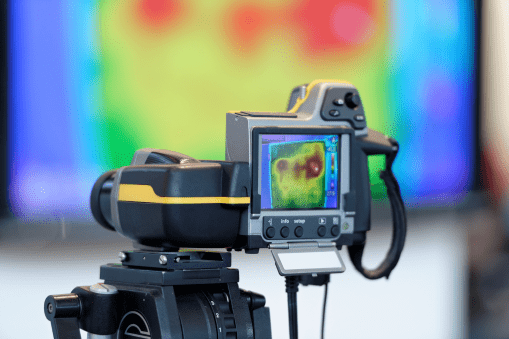
Conducted as per ASTM D4788, IRT is a rapid, large-area, non-contact NDT method. A single operator can scan entire bridge decks, facades or tunnel linings in a fraction of the time of other methods. Global Lab uses FLIR cameras with <50mK thermal sensitivity for high-resolution thermographic surveys.
Infrared Thermal Scanning — Site Images
How the Infrared Thermal Scanning is Conducted
-
1Thermal Condition AssessmentSurvey planned for optimal thermal conditions — 2–4 hours after sunrise or sunset.
-
2Reference Area IdentificationKnown good and defective areas identified for calibration of thermal contrast.
-
3IRT ScanningFLIR infrared camera scans surface systematically. Thermal images captured.
-
4Image AnalysisThermal images processed. Anomalous temperature zones identified and mapped.
-
5Defect ReportAnnotated images, defect maps and repair recommendations. NABL report within 48 hours.
Applicable Test Standards
| Standard | Title | Scope | Type |
|---|---|---|---|
| ASTM D4788 | Standard Test Method for Detecting Delaminations in Bridge Decks Using Infrared Thermography | IRT Bridge Decks | ASTM |
| ASTM E1186 | Standard Practices for Air Leakage Site Detection in Building Envelopes | Building Thermography | ASTM |
| ISO 6781 | Thermal Performance of Buildings — Qualitative Detection of Thermal Irregularities | Building IRT | ISO |
| IS 13311 | Non-Destructive Testing of Concrete — Recommendations | General NDT | Indian Standard |