
Dye Penetration Test
(Liquid Penetrant Testing — NDT)
Surface crack detection in metals using liquid penetrant dye — identifying surface-breaking defects including cracks, porosity, laps and seams in steel, cast iron, aluminium and non-ferrous metals.
What is the Dye Penetration Test (DPT)?
The Dye Penetration Test (DPT), also known as Liquid Penetrant Testing (LPT), uses a coloured or fluorescent penetrant liquid that is applied to a cleaned metal surface and drawn into surface-breaking defects by capillary action. After excess penetrant is removed and developer applied, indications appear as bright red marks on a white background revealing all surface discontinuities.
Conducted as per IS 3658 and ASTM E165, DPT is one of the most widely used surface NDT methods for metals. It requires no special surface preparation beyond cleaning and works on any non-porous material — steel, cast iron, aluminium, copper, titanium and plastics. Global Lab's certified Level II DPT technicians conduct both visible dye and fluorescent penetrant testing.
Dye Penetration Test (DPT) — Site Images
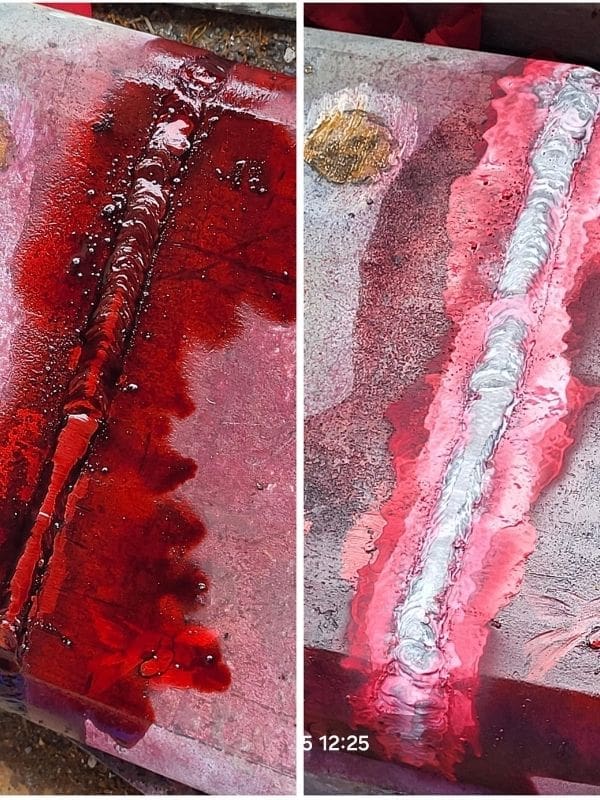
How the Dye Penetration Test (DPT) is Conducted
-
1Surface CleaningMetal surface cleaned with solvent cleaner (Method C) to remove oil, grease, paint and rust.
-
2Penetrant ApplicationRed visible dye penetrant spray applied uniformly. Dwell time: 5–30 minutes per IS 3658.
-
3Excess Penetrant RemovalExcess penetrant wiped with dry cloth followed by solvent dampened cloth — not flooded.
-
4Developer ApplicationWhite developer spray applied. Developer draws penetrant from defects within 7–30 minutes.
-
5Inspection & ReportSurface inspected under adequate visible light (≥1000 lux). Red indications on white background photographed and mapped. NABL report within 24 hours.
Applicable Test Standards
| Standard | Title | Scope | Type |
|---|---|---|---|
| IS 3658 | Code of Practice for Liquid Penetrant Flaw Detection | DPT Standard | Indian Standard |
| ASTM E165 | Standard Practice for Liquid Penetrant Examination for General Industry | Penetrant Testing | ASTM |
| ASNT SNT-TC-1A | Personnel Qualification and Certification in Nondestructive Testing | Technician Qualification | ASNT |
| IS 2595 | Code of Practice for Radiographic Testing | NDT Reference | Indian Standard |