Top 15 Material Testing Standards You Must Know

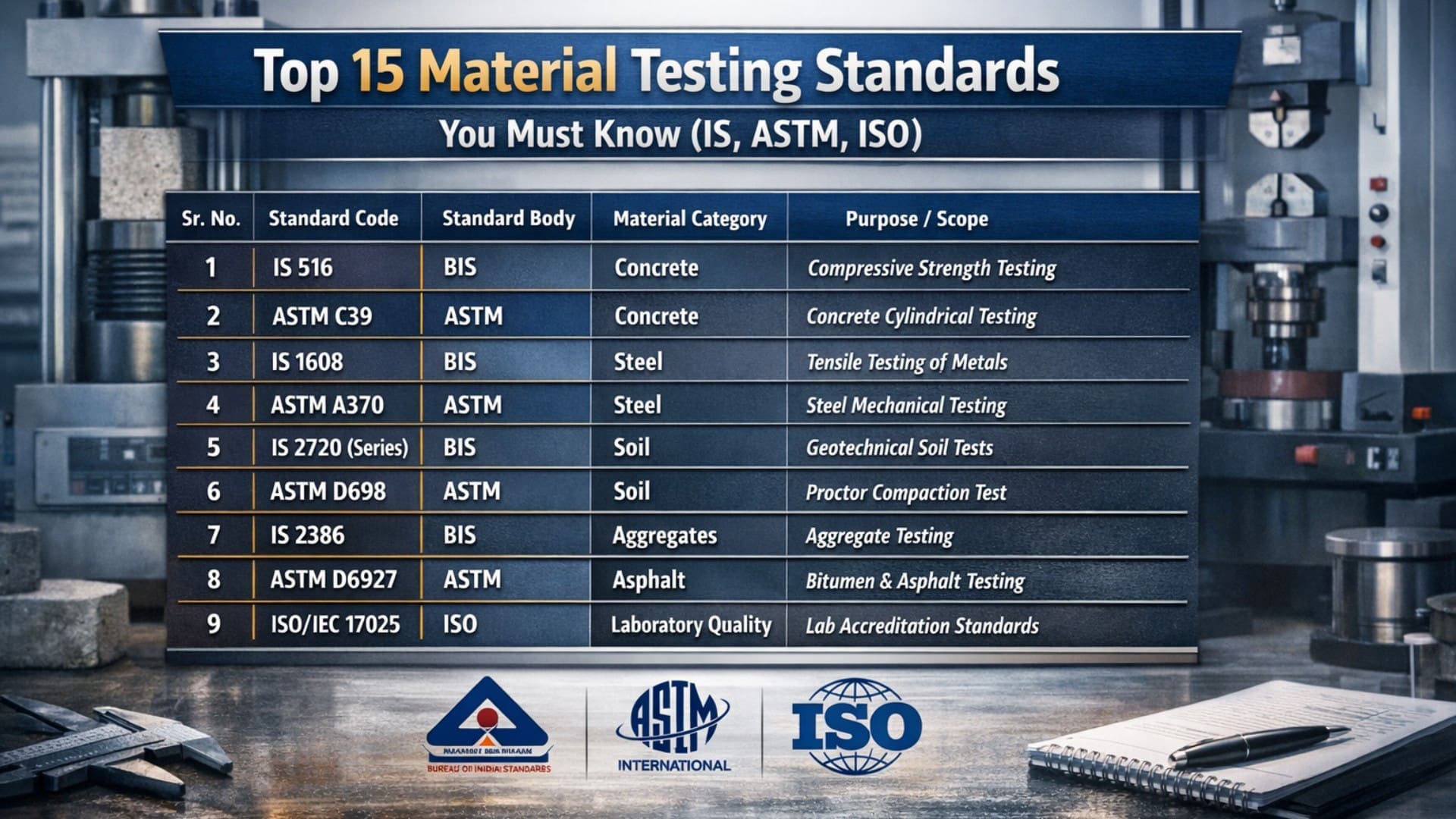
Top 15 Material Testing Standards You Must Know (IS, ASTM, ISO)
In construction and infrastructure, quality is never an assumption — it is proven. Every strong structure, every durable road, and every safe industrial installation rests on one silent foundation: material testing standards.
Standards are not just technical documents. They are shared agreements across engineers, contractors, consultants, and laboratories to ensure that what is designed on paper performs reliably in the real world.
Here’s a carefully curated list of the Top 15 material testing standards every construction professional, QA/QC engineer, and testing laboratory should know.
Understanding the Key Standard Bodies
Before diving into individual standards, it is important to understand the three major frameworks:
- BIS (Bureau of Indian Standards) – Publishes Indian Standards (IS Codes)
- ASTM International – Globally recognised testing standards body
- International Organisation for Standardisation – International quality and process standards
These bodies ensure consistency, reliability, and repeatability in material testing worldwide.
Concrete Testing Standards
1. IS 516 – Methods of Tests for Strength of Concrete
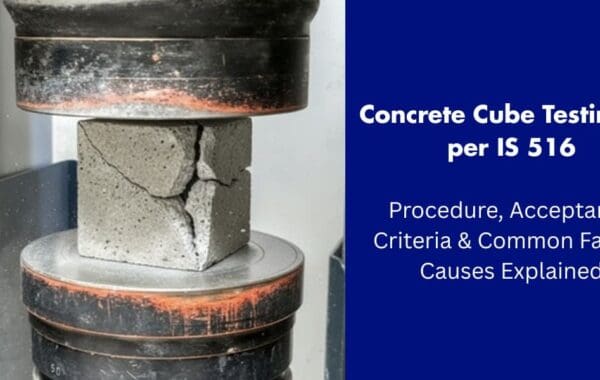
The backbone of compressive, flexural, and split tensile strength testing in India. If you test concrete cubes, this standard defines your procedure.
2. IS 1199 – Sampling and Analysis of Concrete
Specifies slump test, workability, and sampling methods to ensure representative results.
3. ASTM C39 – Compressive Strength of Cylindrical Concrete Specimens
Globally adopted for testing concrete cylinders, especially in international or export-linked projects.
4. ASTM C143 – Slump Test of Hydraulic Cement Concrete
Defines the slump cone method for measuring concrete workability.
Cement Testing Standards
5. IS 4031 – Physical Tests for Hydraulic Cement
Covers fineness, setting time, soundness, and compressive strength of cement.
6. IS 269 – Specification for Ordinary Portland Cement (OPC)
Specifies requirements for 33-grade OPC used widely in Indian construction.
7. ASTM C150 – Standard Specification for Portland Cement
Internationally accepted specification defining cement types and composition.
Steel & Reinforcement Testing Standards
8. IS 1608 – Tensile Testing of Metallic Materials
Used for yield strength, ultimate tensile strength, and elongation testing.
9. IS 1786 – High Strength Deformed Steel Bars and Wires
Critical for TMT bar testing in India.
10. ASTM A370 – Mechanical Testing of Steel Products
Widely used for tensile, bend, and impact testing of steel internationally.
Soil & Geotechnical Testing Standards
11. IS 2720 Series – Methods of Test for Soils
A comprehensive series covering Atterberg limits, compaction, CBR, permeability, shear strength, and more.
12. ASTM D698 – Standard Proctor Compaction Test
Defines laboratory compaction procedures to determine optimum moisture content and maximum dry density.
Aggregates & Bitumen Testing Standards
13. IS 2386 – Methods of Test for Aggregates for Concrete
Includes sieve analysis, impact value, crushing value, and specific gravity tests.
14. ASTM D6927 – Marshall Stability and Flow of Bituminous Mixtures
Essential for road construction quality control.
Calibration & Laboratory Competence
15. ISO/IEC 17025 – General Requirements for Testing and Calibration Laboratories
Perhaps the most important framework for laboratories. This standard defines quality management systems, technical competence, traceability, and uncertainty measurement.
Accreditation under ISO/IEC 17025 demonstrates that a laboratory is technically competent and produces valid results, which is crucial in regulatory, contractual, and legal contexts.
Why These Standards Matter in Real Projects
Standards do three critical things:
Insure Safety
Correct testing prevents structural failures, excessive settlement, cracking, or corrosion risks.
Enable Accountability
When results follow recognised standards, they are defensible during audits, disputes, or compliance reviews.
Build Trust
Consultants, developers, and government bodies prefer projects backed by standardised, documented test procedures.
IS vs ASTM vs ISO – How to Choose?
- Use IS codes for the Indian government and most domestic private projects.
- Use ASTM standards for international collaboration, export-oriented projects, or multinational clients.
- Use ISO frameworks for system-level quality assurance and laboratory accreditation.
Often, modern projects reference multiple standards depending on contractual requirements.
Beyond Compliance: A Strategic Advantage
Forward-thinking organisations do not treat testing as a regulatory burden. They treat it as a risk management strategy.
Testing aligned with recognised standards:
- Reduces long-term maintenance costs
- Enhances brand credibility
- Supports project approvals
- Improves investor and stakeholder confidence
In today’s competitive construction environment, quality documentation backed by global standards is not optional — it is a differentiator.
Final Thoughts
Material testing standards are the technical language of construction integrity. Whether it is concrete strength, steel ductility, soil compaction, or cement quality, these standards provide clarity and consistency across projects.
When projects adhere to recognised IS, ASTM, and ISO standards, they move beyond compliance — they build trust, durability, and long-term value.
If your organisation aims to deliver resilient, future-ready infrastructure, aligning with the right testing standards is the first step toward building with confidence.